(Original title: From “price” to “value”, Chinese clothing embraces branding overseas)
In 1978, a French fashion designer named Pierre Cardin came to China for the first time. At that time, on the streets of Beijing, pedestrians still wore cotton or "Chenliang" (the Cantonese homophone of the English word Dacron for polyester) clothes. Most of them were black, blue, gray or military green, which was a bit simple and monotonous. Pierre Cardin, who had a keen business sense, realized that the changes that were about to take place here would create an unparalleled blue ocean.
A year later, Pierre Cardin held his first fashion show at the Palace of National Culture in Beijing, bringing overseas fashion concepts to China. Since then, many international brands have successively brought mature management experience, manufacturing technology and brand systems, which have promoted earth-shaking changes in Chinese people's dressing concepts.
China's local clothing industry is also developing and growing through opening up and exchanges. With extremely advantageous labor costs, by the mid-1990s, China's clothing manufacturing capabilities had greatly improved, and both output and export volume had ranked first in the world. As the supply chain advantages of the clothing industry continue to evolve, Chinese clothing has achieved a transition from "bringing in" to "going out". The "brand awareness" of local clothing brands is also increasing day by day, and a number of world-renowned national brands such as Li Ning and Bosideng have emerged. . In recent years, with the vigorous development of emerging models such as cross-border e-commerce, many emerging brands have also been able to take advantage of the combination of China's supply chain and digital trade to complete their global layout overseas and improve their design, product innovation, and branding. Continuously improve its own capabilities in other aspects, and gradually grow from "Made in China" to a "global brand".
Continuous innovation , Chinese clothing shows growth resilience
In 2024, the global apparel industry is expected to reach US$1.79 trillion and will continue to grow in the next five years. After more than 40 years of accumulation, China has the largest and most complete clothing industry system in the world. In 2023, the annual output of clothing will exceed 70 billion pieces, accounting for more than half of the world. It has also been at the forefront in terms of global clothing export share. As Chinese clothing accelerates its overseas expansion, Chinese clothing companies are no longer content to rely solely on supply chain and price advantages to develop business. Instead, they are creating higher premiums and achieving sustainable growth by continuously increasing brand building. Among them, Amazon, as one of the preferred destinations for consumers in many countries and regions to buy clothing and discover brands, has become one of the important channels for Chinese clothing companies to go overseas. In recent years, many national brand clothing have emerged on Amazon. They have used material innovation, quality upgrades, brand building and other means to directly face hundreds of millions of consumers around the world, and have created a good reputation and image.
Relying on the "flexible supply chain" of continuous innovation and upgrading, some Chinese clothing brands have established a "small order and quick reaction" model from trend insight, design and proofing, production and manufacturing to rapid introduction of new products, to quickly capture changes in overseas popular elements. , shortening the new clothing cycle to the extreme. According to data analysis by the China National Textile and Apparel Council on more than 10,000 textile companies across the country, as of June 2023, 56.8% of companies in the industry have fully digitized key business links such as R&D, design, production and manufacturing, and operations management. Based on a strong digital supply chain, Chinese clothing companies can complete the entire process from design to delivery within a week, launch tens of thousands of new products every year, and provide global consumers with richer and more cutting-edge fashion choices.
Some Chinese clothing brands choose to invest in innovation in materials, technology, processes, etc., and use technological and functional breakthroughs to cross the industry cycle and seek greater growth. For example, in the recently popular outdoor sports track, some Chinese clothing brands have continuously optimized fabric selection to improve waterproof performance while bringing a more comfortable daily wearing experience, "creating a new path on the outdoor sports track where strong players gather." ”, with its unique positioning, outstanding quality and unique wearing experience, it has established a firm foothold overseas.
At the same time, many Chinese clothing brands have begun to pay attention to the role of marketing. By seeking emotional resonance with consumers, they have attracted more overseas consumers with brand concepts that are more in line with local culture. For example, baleaf, founded in 2014, is a sportswear brand that started on Amazon. Its first product, the "027" cycling shorts, achieved monthly sales of over 10,000 pieces on Amazon. On its way overseas, baleaf insists on focusing on brand building, and pays special attention to issues of concern to overseas consumers such as sustainable development. In 2022, baleaf will use recyclable materials such as plastic bottles and fishing nets to convert into high-quality regenerated nylon and regenerated polyester fiber, and launch a variety of sustainable products.
To face the changes , Chinese clothing needs new strategies to go global
Although Chinese clothing brands have demonstrated strong growth resilience on the international stage, they are also facing new changes in overseas markets at any time. As Gen-Z and Millennials become the “main force” of consumption, the importance of brands has been further strengthened. A survey shows that 84% of Gen-Z adults will choose to buy products and support brands based on their own values.
Focusing on the clothing category, consumers’ purchases also show high-frequency and personalized characteristics. Research shows that 69% of apparel customers start researching new purchases within one day of purchase. At the same time, not only do Generation Z adult fashion customers rarely purchase clothing from the same brand “from head to toe”, but they are also not obsessed with well-known brands. Young consumers often regard dressing style as a way to express themselves. Their choices are more diversified and personalized, such as minimalist, retro, street... Each clothing style can find its own segmented audience, which also Give small and medium-sized brands more opportunities to stand out.
At the same time, the media channels through which consumers know and understand brands are also changing. Especially with the rise of mobile Internet, from streaming media to live broadcast, from music to podcasts, people's attention has become more fragmented. Consumers will constantly switch between browsing, watching, searching and purchasing products, and will also switch from Obtaining information from different channels such as Internet celebrity "planting", customer reviews or video advertisements, this forces Chinese overseas clothing brands to learn to use excellent creativity to gain consumers' attention through diversified channels to promote brand building and sales growth. .
One important trend that cannot be ignored is the rise of video media. In 2023, Americans will watch a cumulative 21 million hours of streaming content, an increase of 21% from the previous year. For example, Prime Video, one of Amazon's most influential streaming services, supports more than 30 languages, covers more than 240 countries and regions, and provides a large amount of high-quality content to more than 200 million Prime members around the world, including Popular movies and TV series like "The Lord of the Rings" and "The Marvelous Mrs. Maisel" and award-winning Amazon originals, including "Thursday Night Football," the Champions League, and French Open Wait for live broadcast of exciting events. Overseas consumers can also watch movies and TV series on Amazon's Freevee, watch online live broadcasts on Twitch, which has more than 35 million daily visitors worldwide, or watch current news, lifestyle and other interesting content on Fire TV Channels .
In addition, Generation Z, who grew up in the digital age, are more accustomed to sharing opinions and enjoying life online. 71% of Generation Z consumers were inspired to purchase a product or service for the first time from social media. To attract consumers' attention on social media, it is also inseparable from the creative expression of visual content.
Diverse solutions help Chinese clothing brands tell global stories
Amazon covers a wide range of media layouts such as shopping malls, streaming services, and hardware devices in many countries and regions around the world, continuously innovative advertising products and technologies, user insights based on shopping, entertainment, life and other scenarios, as well as continuously strengthening its presence in China. Local support, etc., to help Chinese clothing brands tell their brand stories globally and provide support. Not only clothing brands on Amazon, but also clothing brands that adopt multi-channel global layout can also use Amazon's global diversified marketing touch points and advertising solutions to build global brands.
First of all, in the face of a more decentralized and fragmented media environment and the strong rise of video media, Amazon provides the world's leading media matrix, especially rich video resources. This year, Amazon Prime Video advertising has been launched in the United States, the United Kingdom, Germany, Canada, France, Italy, Spain and Mexico, helping advertisers reach an average of 200 million global consumers every month, including 115 million U.S. consumers, and will continue to do so in the future. Continuously expand to more countries and regions. Brands can also leverage Amazon streaming TV advertising to reach an average of more than 175 million consumers per month in the U.S. on Freevee, Fire TV Channel, Thursday Night Football, Twitch and other channels. In addition, brands can use Amazon DSP and Amazon publisher direct to advertise on thousands of high-quality media channels around the world to increase brand attention and purchase intentions on a larger scale, including Harper's Bazaar, GQ, ELLE, and NBC, CBS Sports and other globally influential fashion and sports platforms.
Sponsored TV, launched by Amazon Advertising, can help brands of all sizes reach target consumers through streaming content on Freevee, Twitch and Amazon devices in a flexible and simple way, with no advertising minimums Limitations on activity expenditures, minimum daily expenditures, and advance commitment expenditures give more small and medium-sized brands the opportunity to reach the audience in front of the big screen and conquer more consumers with unique brand stories.
Secondly, Amazon Advertising continues to innovate and launch diversified advertising products and tools to help brands achieve better marketing results through multi-channel delivery strategies. For example, brands can use Prime Video, Twitch, etc. to increase brand exposure, attract traffic through search ads such as product promotion and brand promotion, or use tools such as brand flagship stores and posts to accumulate loyal fans of the brand and increase repurchase and conversion. With the multi-channel reach of Amazon Advertising, advertisers can effectively drive the conversion from traffic to business. Research shows that advertisers who choose four advertising strategies have a sales growth rate of more than 40%, a new customer growth rate of more than 28%, and a repurchase growth rate of more than 52%.
Third, Amazon Advertising also relies on the continuous innovation of advertising technology to help brands plan and optimize marketing activities based on data insights. For example, based on Amazon’s unique first-party insights and third-party data on billions of shopping, browsing and streaming signals, Amazon DSP allows brands to customize delivery based on different audience groups such as demographics, lifestyles, interests, etc. Precisely reach segmented audiences at the right time. In addition, Amazon Marketing Cloud helps advertisers analyze and build customized audiences based on Amazon and the brand's own anonymized signals in a secure and privacy-protecting environment, and conduct cross-channel consumer journey and advertising campaigns. Conduct in-depth analysis to improve consumers’ purchasing decisions and optimize advertising effects.
Finally, Amazon Advertising also has numerous innovative programs that provide brands with opportunities to create more impactful creative marketing campaigns. For example, brands can use the Amazon Influencer Program to collaborate with online creators or celebrities to create content and reach their massive fan base on social media, or they can cooperate with Amazon’s fashion project The Drop to showcase limited edition series and must-have items. Cooperate with products or exclusive brands to inspire more overseas fashion people and lead the trend.
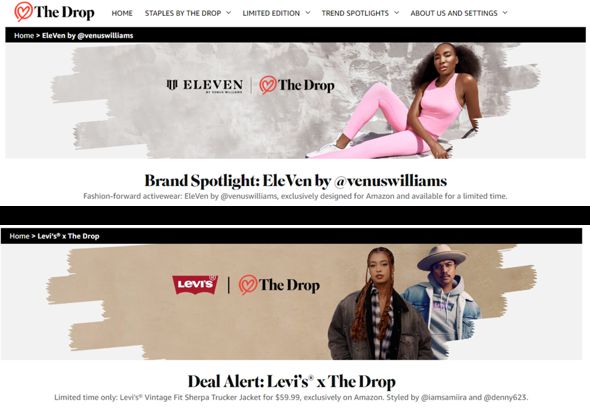
Venus Williams' own brand ELEVEN, Levi's and The Drop collaborate
In The Drop's cooperation list, there are not only international clothing brands such as New Balance, Levi's, and Champion, but also many Chinese local clothing brands going overseas. In 2022, Chinese clothing brand OROLAY cooperated with Amazon Advertising and The Drop to "limit the sale" of a number of star items, and through a combination of different channels such as Internet celebrity planting, social media, on-site advertising, and offline physical store displays. , reaching more users who love fashion and pursue trends. During the launch period, the order volume increased by approximately 32%, gaining greater brand exposure.
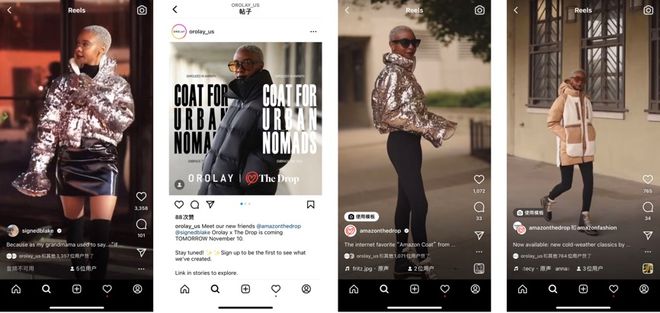
Clothing brand Orolay collaborates with Amazon Advertising and The Drop on Internet celebrities